
AI Fast and Slow
The psychology behind our decision making comes down to System 1 and System 2.
When it comes to work and AI, I've seen most things break down into this framework, and a clash between the two.
For context, System 1 is the brain's system for doing things on autopilot, quick and easy, top down. System 2 is the system that works harder, thinking through something difficult, bottom up.
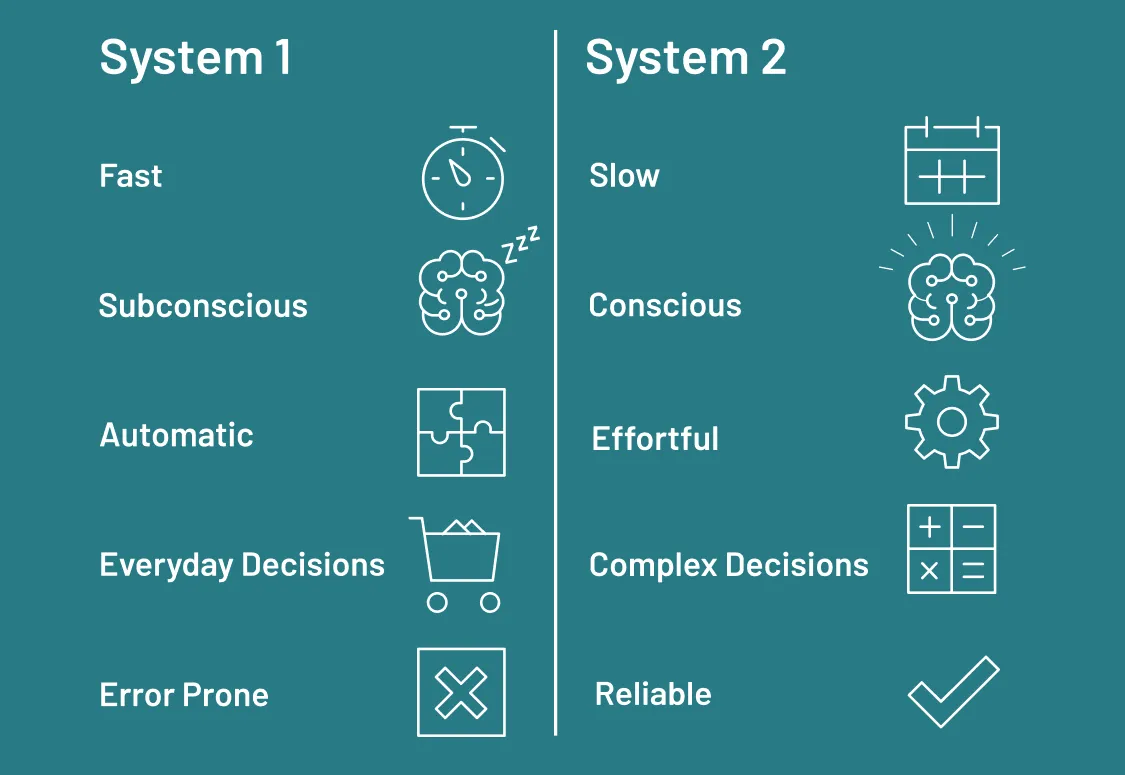
In short, we can attribute System 1 to easy tasks and System 2 to difficult ones. Tasks and work that have friction usually pull us into a System 2 mindset. I think the current issue with most people's use of AI is that it violates the balance between the two.
Difficult things should be difficult and easy things should be easy, that's the point of having two systems in the first place. Unfortunately, because of AI's mass knowledge pulled from the public, most if not eventually all things will be easily accessible and done for us. The journey to make something happen has been replaced by an all-purpose shortcut, and we're seeing it shift our lives in a big way. Students who used to have to write papers now hand over a document and tell the AI to write the whole thing. Engineers can write code while taking a walk around the park. The work and effort required have been effectively removed from a lot of common critical thinking tasks.
As someone who makes a lot of art and works with a lot of engineers, many of us take pride in the hard work it takes to bring something to life. The journey itself is what builds our attachment to the outcome. As you make something, the work shifts with new ideas and influences along the way. When I make something with AI, it's usually one or two prompts to get an MVP, versus hours of work to make something usable by hand. That drop in effort feels like it's cascading, and the incentives from the top only push it further.
We've already seen how easy access to content shows up as a negative in kids, think Baby Shark on loop. Why wouldn't the same apply to us as adults? Our brains are still plastic, they can be remolded, for better or worse. The brain is a muscle, it grows stronger through hard work, breakdown, rest, and rebuilding. There are already studies comparing people who use AI or search engines against people who use their own brain to write papers, and brain connectivity is much higher in the ones writing on their own.
It might be conjecture, but AI is making us dumber, because there's no need to retain information anymore. Why should I learn and hold onto something if I can just outsource the recall to a second AI brain? In a work context that might be useful, but I can easily see this kind of easy access working against us as we lose the ability to train and grow our own brains. At a time when the average person is more educated than the generation before them, we're slowly making ourselves dumber than that older generation.
That's probably why I've been trying to add friction back into my life, so I don't erode my own critical thinking. You lose what you don't use, so my focus right now is retraining that muscle and making sure it isn't handed off to a system I don't understand. It's part of why I still try not to reach for AI first, whether I'm making art or writing something like this. I'll admit it's incredibly tempting to just let AI write everything or run my main tasks, especially when I'm being incentivized to. But my focus is on self-improvement wherever I can find it, and if that means a sharper brain, I think it's worth it.
I don't know what the full solution is yet, beyond forcing myself to think and do the work. There are times I just want an answer, like with a math problem, but when a task actually requires thinking, it's better to force myself through it than to hand it off. A lot of my colleagues have picked up a similar habit, adding friction back in by sketching ideas out or writing a full draft before bringing AI in to edit. I still think there's a balance to be found.
If there's one thing to take from this, it's to stay conscious of what you reach for when you have a question or a task. Being deliberate about how we use AI is what's going to save our brains going forward.
Inspirations/References:
www.scientificamerican.com/article/kahneman-excerpt-thinking-fast-and-slow
en.wikipedia.org/wiki/Thinking,_Fast_and_Slow (Wikipedia article on the book)